

Academic visit integrates internationalization initiatives and strengthens partnership between the institutions.
On the morning of Tuesday (9), the International Relations Office (REINTER) welcomed Professor Diego Moisés Almazo Pérez, from the Autonomous University of Ciudad Juárez (UACJ), Mexico. Through the Latin American Academic Exchange Program (PILA), the professor’s academic visit is part of initiatives aimed at strengthening internationalization at FURG.
Throughout the week, the professor will carry out an academic program focused on knowledge exchange and the presentation of teaching practices from UACJ, contributing to scientific dialogue between the universities. The visit also encourages the expansion of this partnership by exploring new possibilities for cooperation that benefit both institutions.
Professor Pérez was welcomed by the Academic Mobility Coordinator at REINTER, Nicole Feijó, along with Kleber Eduardo Bianchi, a FURG professor responsible for accompanying him during his activities at the institution. While receiving the professors, the coordinator highlighted the importance of promoting faculty mobility between universities:"Faculty mobility is just as important as student mobility. It strengthens partnerships between universities, as it allows for the circulation of knowledge, the exchange of teaching methodologies, and the development of joint research."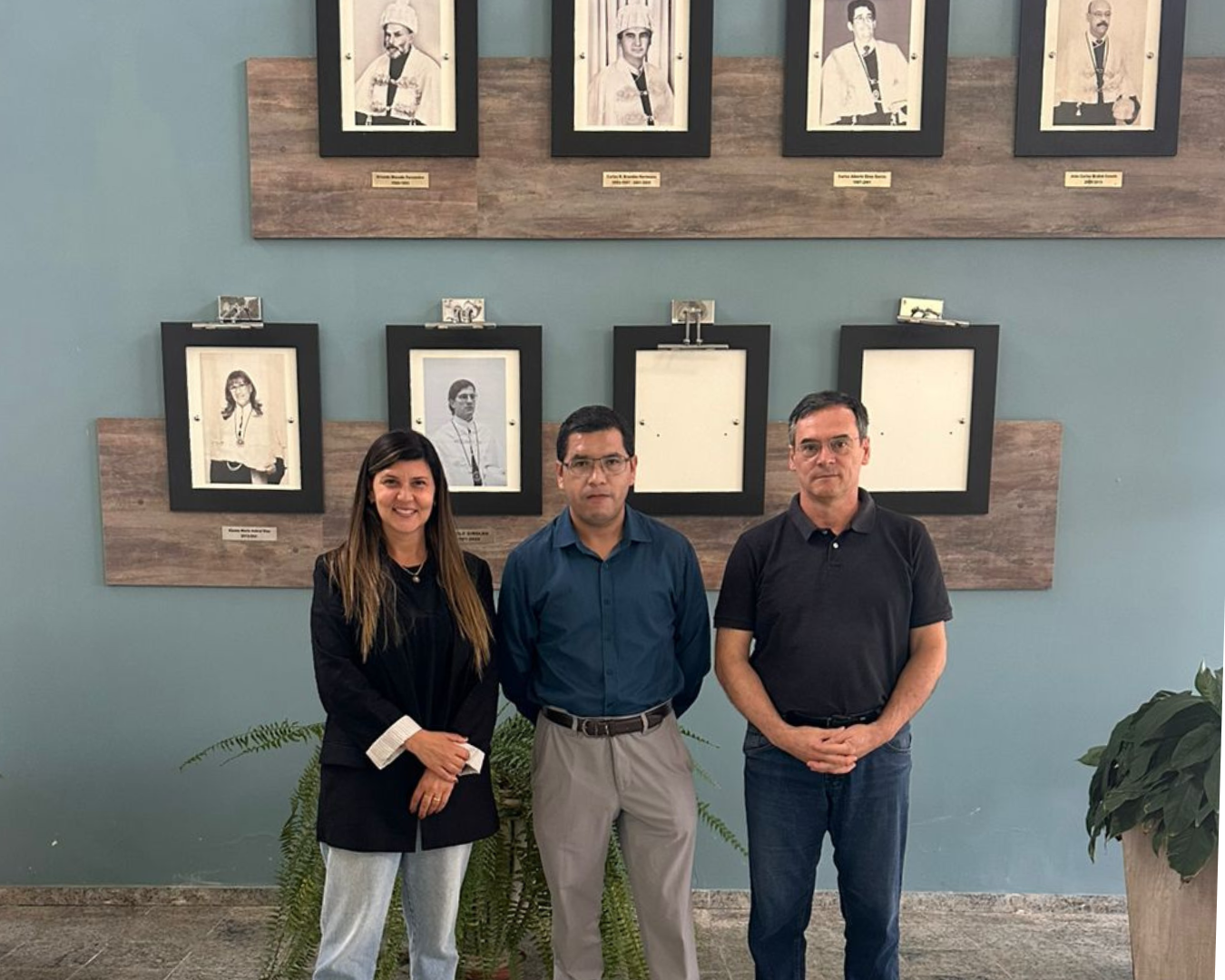
REINTER Academic Mobility Coordinator Nicole Feijó welcomes visiting professor Diego Almazo Pérez from the Autonomous University of Ciudad Juárez (UACJ), alongside FURG professor Kleber Eduardo Bianchi.
During his stay, Pérez will carry out academic activities at the FURG School of Engineering, promoting knowledge exchange and presenting teaching experiences from UACJ. Among his activities is a short course on the Finite Element Method (FEM), taught by Pérez until December 12.
Aimed at undergraduate and graduate students from different engineering fields, the course will address several topics, including static analysis of corner supports in structures, solidification of cast parts in heat transfer processes, modal analysis of aircraft wings in aerospace engineering, and 2D structural analysis applied to robotics, among others.
With this academic visit, the Academic Mobility Coordinator also emphasized the broader benefits of faculty mobility:"Faculty mobility allows professors to enhance their professional skills while creating collaboration networks that strengthen interinstitutional agreements. It has become a strategic element for increasing academic quality, institutional visibility, and the social impact of universities."